
Our History
For more than 65 years the organisations that became Disability Sports Australia have helped shape disability sport in Australia.
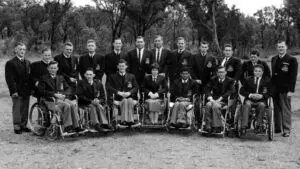
From the first wheelchair sport programs connected to spinal rehabilitation units through to national participation systems, major international events and the development of new sports, DSA and its predecessor organisations have played a significant role in the growth of disability sport across Australia.
This history spans wheelchair sport, amputee and locomotor disability sport, and cerebral palsy sport, three distinct disability sport movements that developed national structures independently before coming together through Australian Athletes with a Disability in 2003 and becoming Disability Sports Australia in 2013.
Across several decades these organisations coordinated Australian Paralympic teams, developed national championships, built participation programs and advocated for disability sport across Australia.
Three of DSA’s predecessor organisations were founding members of the Australian Paralympic Federation in 1990, now known as Paralympics Australia.
Disability sport organisations were central to the development of sport for people with disability in Australia, serving not only as delivery organisations but also as national governance structures, advocacy voices and participation systems that made sustained involvement in sport possible across the country.
Over time DSA and its members helped develop and transition sports into mainstream sporting structures, including wheelchair basketball, wheelchair rugby, lawn bowls and recently AFL Wheelchair.
Today DSA works with its members, sporting organisations, governments, clubs and communities across Australia to increase participation opportunities for people with disability and strengthen how sport is delivered nationally.
Where it all began
In the wards of Royal Perth Hospital Sir George Bedbrook introduced sport as part of recovery for people with spinal injuries. Inspired by the work of Sir Ludwig Guttmann at Stoke Mandeville Hospital in England, sport became a pathway not only to rehabilitation but to community participation and independence. From these programs grew Australia’s first organised wheelchair sport movement.
Australia competes internationally for the first time
Australia sent its first athletes with disability to the International Stoke Mandeville Games in England, the competition that later became the Paralympic Games.
Australia at the first Paralympic Games: Rome
Australian athletes with disability competed at the inaugural Paralympic Games in Rome in September 1960.
The team was coordinated by one of DSA’s founding predecessor organisations, representing a significant milestone in the development of organised disability sport in Australia.
Coordinating Australia's Paralympic teams
DSA’s predecessor organisations coordinated Australian Paralympic teams for more than two decades prior to the establishment of the Australian Paralympic Federation, helping build disability sport systems across Australia through national championships, athlete pathways, classification, coaching and international team coordination.
National Wheelchair Games established
A biennial national wheelchair sport competition was established across every state and territory, creating a pathway to international competition for Australian athletes with disability. Over time the National Wheelchair Games became Australia’s primary national competition and talent pathway for wheelchair athletes.
Australian Paraplegic and Quadriplegic Council established
The Australian Paraplegic and Quadriplegic Council was established by state paraplegic associations to coordinate disability sport nationally.
The organisation later evolved into the Australian Paraplegic and Quadriplegic Sports Federation and subsequent national wheelchair sport structures that became part of Disability Sports Australia.
Australia hosts the world
Perth hosted the inaugural Commonwealth Paraplegic Games, the first international disability sport event held in Australia.
The Games were driven through Royal Perth Hospital, Sir George Bedbrook and Australia’s emerging national paraplegic sport structures coordinated through the APQC.
Sport gets its own governance
The Australian Paraplegic and Quadriplegic Sports Sub Committee (APQSSC) assumed responsibility for organising Australian disability sport teams for international competition.
The APQSSC later formed the basis of the Australian Wheelchair Sports Federation (AWSF), creating dedicated national sports governance structures separate from rehabilitation and welfare administration.
A cross disability movement emerges
The Australian Confederation of Sport for the Disabled (ACSD) was established at a national meeting held at the Royal Adelaide Hospital.
The ACSD brought together organisations across different disability groups for the first time nationally, including:
- wheelchair sport
- blind sport
- cerebral palsy sport
- amputee sport
- deaf sport
Australian Paraplegic and Quadriplegic Sports Federation established
The Australian Paraplegic and Quadriplegic Sports Federation (APQSF) was formally established as Australia’s national wheelchair sport body.
The APQSF became a direct predecessor organisation within the institutional history of Disability Sports Australia.
Sydney hosts sixteen nations
The APQSF hosted the Far East and South Pacific Games (FESPIC Games) in Sydney, bringing together athletes from sixteen nations.
The Games directly contributed to the establishment of the Amputee Sporting Association of Australia (ASAA), which later became the Australian Sports Organisation for the Disabled (ASOD).
Amputee sport structures formalised nationally
The Amputee Sporting Association of Australia (ASAA) was established in Toowoomba to support people with amputations and other locomotor disabilities to participate in rehabilitation, recreational and competitive sport nationally.
The organisation later evolved into:
- the Amputees Federation of Australia (AFA)
- the Australian Sports Organisation for the Disabled (ASOD)
ASOD later became one of the three organisations that merged into Australian Athletes with a Disability (AAWD).
Disability sport moves into the Australian Sports Commission
The Australian Sports Commission (ASC) assumed responsibility for federal disability sport policy and funding following the dissolution of the National Committee on Sport and Recreation for the Disabled (NCSRD).
The ASC established the Sport for All Committee and formally integrated disability sport into Australia’s national sports policy system.
Founding the Australian Paralympic Federation
The Australian Paralympic Federation (APF), now Paralympics Australia, was established on 25 January 1990.
Founding member organisations included:
- Australian Wheelchair Sports Federation (AWSF)
- Australian Sports Organisation for the Disabled (ASOD)
- Cerebral Palsy Australian Sport and Recreation Federation (CPASRF)
These organisations later became part of Disability Sports Australia’s institutional history through the formation of Australian Athletes with a Disability (AAWD) in 2003.
Australian Wheelchair Athletes Limited formed
The Australian Paraplegic and Quadriplegic Sports Federation was reconstituted as Australian Wheelchair Athletes Limited, reflecting the expanded mandate beyond spinal injury athletes to include all wheelchair sport.
Sydney secures the Paralympic Games
Sydney secured the 2000 Olympic and Paralympic Games following advocacy led by disability sport leaders including Ron Finneran and Adrienne Smith to ensure the Paralympics were fully embedded within the bid.
The decision transformed disability sport visibility and investment nationally.
Wheelchair Sports Australia Established
Australian Wheelchair Athletes Limited formally became Wheelchair Sports Australia (WSA), continuing national wheelchair sport governance across Australia.
WSA later became one of the organisations that merged into Australian Athletes with a Disability.
Australia tops the Paralympics medal table
Australia finished first on the medal table at the Sydney 2000 Paralympic Games with:
- 63 gold medals
- 39 silver medals
- 47 bronze medals
Three organisations become one
At the request of the Australian Sports Commission three national organisations merged to form Australian Athletes with a Disability (AAWD):
- Wheelchair Sports Australia (WSA)
- Australian Sports Organisation for the Disabled (ASOD)
- Cerebral Palsy Australian Sport and Recreation Federation (CPASRF)
A national disability sport system takes shape
Following the merger Australian Athletes with a Disability (AAWD) became one of Australia’s largest cross sport disability sport structures.
AAWD coordinated national championships, participation programs, athlete pathways, classification systems, coach and official development and regional club support across Australia.
By 2011 AAWD and its members represented approximately 6,000 athletes, officials, coaches and volunteers nationally and supported more than 350 participation programs and competitions each year.
Members vote for a new constitution
Members voted to adopt a new constitution, strengthening governance and establishing DSA as the peak national body for physical disability sport in Australia.
Disability Sports Australia
Australian Athletes with a Disability publicly became Disability Sports Australia, establishing one strong national identity as the peak body for physical disability sport in Australia.
Wheelchair basketball transitions to Basketball Australia
DSA transferred administration of the National Wheelchair Basketball League and Women’s National Wheelchair Basketball League to Basketball Australia, completing a transition process that had begun with the Wheelchair Basketball Reference Group in 2010.
Inaugural national Wheelchair Aussie Rules Championship
Disability Sports Australia and the Australian Defence Force hosted the inaugural national Wheelchair Aussie Rules Championship.
The AFL announced a national partnership with Disability Sports Australia to support the growth of Wheelchair Aussie Rules across Australia. The sport is now commonly known as AFL Wheelchair.
Australia awarded the Wheelchair Rugby World Championship
Disability Sports Australia secured the rights to host the 2018 IWRF Wheelchair Rugby World Championship in Sydney.
The successful bid represented one of the most significant international hosting achievements in the organisation’s history and positioned Australia to host the world’s premier wheelchair rugby event for the first time.
Australia hosts the Wheelchair Rugby World Championship
Disability Sports Australia hosted the GIO 2018 IWRF Wheelchair Rugby World Championship in Sydney, the first time the event had been held in Australia.
More than 5,000 spectators attended, including over 1,500 school students.
Invictus Games Sydney
Disability Sports Australia contributed disability sport expertise to the Invictus Games Sydney 2018, supporting wheelchair rugby, wheelchair basketball and sitting volleyball competition delivery.
Wheelchair Rugby Australia launched
Disability Sports Australia launched Wheelchair Rugby Australia (WRA) as a dedicated national division focused on the development and growth of wheelchair rugby across Australia.
Sports Incubator established
Disability Sports Australia formalised its Sports Incubator model, designed to develop disability sports and participation opportunities before transitioning mature sports into independent or mainstream sporting structures.
Lawn bowls transitions toward Bowls Australia
Following several years of collaboration, multi-disability lawn bowls entered the final stages of integration into Bowls Australia structures, with DSA transitioning from direct management into a consultation and development role.
Disability Sports Northern Territory established
Disability Sports Northern Territory launched to increase disability sport participation opportunities across the Northern Territory
Wheelchair rugby broadcast nationally for the first time
Wheelchair Rugby Australia, operating as a division of DSA, secured Kayo Sports as the official streaming partner of the 2021 GIO Wheelchair Rugby National Championship on the Gold Coast, the largest national broadcast deal for a domestic disability team sport in Australia at the time.
Blacktown Disability Sports Centre bid secured
Disability Sports Australia and Blacktown City Council secured NSW Government funding through the Office of Sport’s Centre of Excellence Fund for the Blacktown Disability Sports Centre in Western Sydney.
The $30.5 million project established the foundation for Australia’s first purpose-built indoor disability sports centre.
First national disability sport conference held
DSA hosted the inaugural National Disability Sports Conference on 16 June 2022 at USC Stadium on the Sunshine Coast, bringing together more than 200 leaders from across sport, disability, education, allied health, government and community. The conference theme was the Runway to Brisbane 2032.
Wheelchair Rugby Australia becomes fully independent
Wheelchair Rugby Australia formally became a fully independent national organisation, completing the transition that began in 2019
Toyota Wheelchair AFL National Championship broadcast nationally
The 2022 Toyota Wheelchair AFL National Championship featured teams from every state and territory for the first time and was broadcast nationally through Kayo Freebies and ABC Sport.
The championship marked an important step in the national growth and visibility of AFL Wheelchair and the beginning of the sport’s transition into AFL structures.
Changing Lives Through Sport
DSA launched Australia’s first national grassroots disability sport storytelling campaign, supported by the Australian Sports Commission and aligned to Play Well.
The campaign reached more than 1.19 million Australians and marked a significant national awareness and visibility initiative focused on grassroots disability sport participation.